
From a Napkin Sketch to the Heart of Retro Gaming Bar
The story of how a simple idea became eleven custom-built gaming tables, and why I apparently couldn't just buy some furniture like a normal person.
A Hobby That Wasn't Supposed to Make Money
Our story begins in 2015, long before Retro Gaming Bar existed, when I was experimenting with open-source software that could bring classic video games back to life on modern hardware. I'd spent a considerable amount of time exploring how everything worked, experimenting with different configurations, and eventually building a little retro gaming system for my home. I even managed to integrate Kodi, turning it into something that could do more than simply play video games. I found the whole thing fascinating. It was the kind of hobby that makes you lose track of time because every little discovery opens the door to another possibility. One evening, we had friends over for dinner. As the conversation went around the table, everyone started sharing what they'd been working on recently. When my turn came, I enthusiastically began describing my little project, how much I'd learned, and how excited I was about the possibilities. I was interrupted by a question.
"Why are you doing all this? Are you ever going to make any money out of it?"
The question came with a rather condescending tone, and the rest of the table started laughing. I remember that moment surprisingly well. Not because I'd secretly been planning some grand business venture, but precisely because I hadn't. I wasn't trying to make money. I was simply doing something I genuinely enjoyed, and apparently that wasn't a sufficient reason to spend time on it. For several days afterward, I couldn't get the conversation out of my head. Part of me was offended, especially since this had happened in my own home. But more importantly, it made me question something I'd never really considered before. Why does everything we create have to be measured by how much money it makes?
Over the following years, that question gradually shaped how I thought about business, products, and value. I came to believe that the best products are the ones that give people something meaningful. Something useful, enjoyable, memorable, or simply capable of putting a smile on someone's face. And sometimes, the best things are the ones we get to share with others. If people appreciate what you've created enough to pay for it, wonderful. That makes it possible to keep developing and improving it. But I never wanted the pursuit of profit to become the reason for building something in the first place. When the idea for Retro Gaming Bar eventually took shape, that philosophy came with it. I didn't want to build a business around extracting as much money as possible from a nostalgic concept. I wanted to create a place where people could enjoy the games I loved, share the experience with friends, and maybe rediscover a little of the excitement we felt growing up. Whether that would become a profitable business was something our future customers would ultimately decide. My job was to make the experience worth coming back for.
Content from TikTok is disabled.
Enable it in - Cookie Settings
Why Couldn't We Just Buy Some Gaming Tables?
When I started imagining how Retro Gaming Bar would actually work, one question immediately became obvious. Where were people going to play? I didn't want a conventional arcade filled with machines where everyone stood facing a cabinet. I also didn't want a few consoles connected to televisions scattered around an ordinary bar. I wanted people to sit comfortably, talk to each other, enjoy their drinks, and play together without the gaming equipment dominating the entire space. The gaming tables needed to become part of the furniture, not something awkwardly added to it. They also needed to be comfortable, practical, maintainable, durable, and visually distinctive. And because I already had a very particular idea in my head, finding something ready-made that satisfied all those requirements was never particularly realistic. So I decided we would design our own. How difficult could designing a table possibly be? If you've read any of my other stories, you already know that this is usually the point where everything starts going wrong.
Step One: An Architectural Masterpiece. Almost.
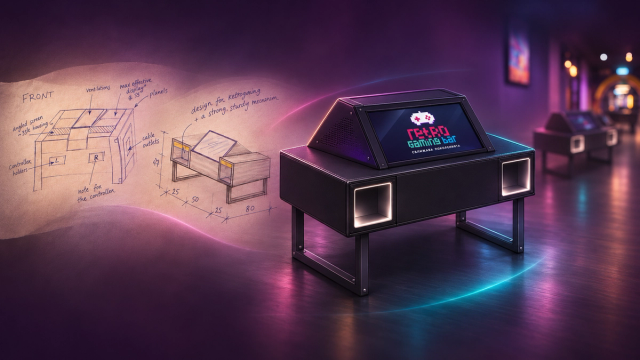
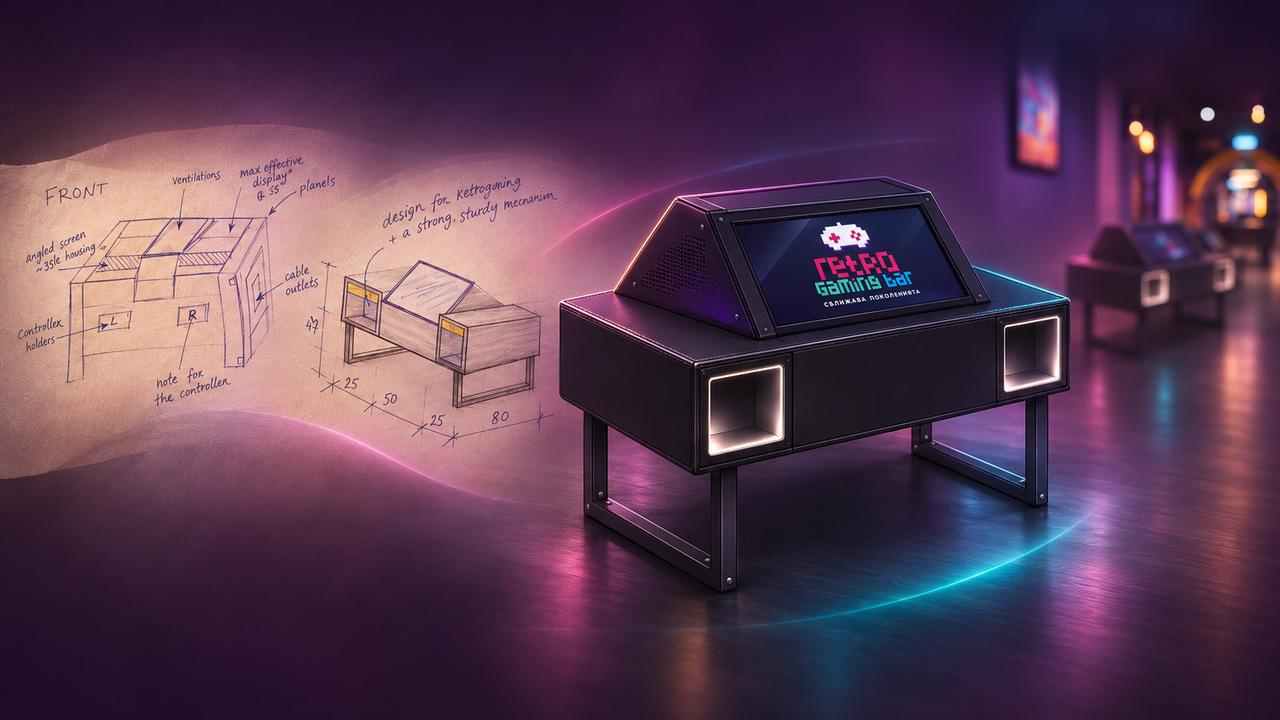
I began with a drawing. Calling it a technical drawing would be an insult to technical drawings everywhere. It was more of an attempt to transfer the strange object floating around inside my head onto a piece of paper. There were screens, angled surfaces, controller openings, supporting structures, and various dimensions that seemed perfectly reasonable to me at the time. I needed someone who actually knew how to draw furniture to turn this masterpiece into something a professional could understand. So I found a designer through an online marketplace and started explaining what I wanted. After plenty of back-and-forth communication, we eventually produced a proper technical drawing and, later, a beautiful rendering of the concept. I was thrilled. It looked fantastic. I could finally see the table I'd been imagining, and for a brief, wonderful moment, I thought the difficult part was over. Then I took the design to a woodworker. He took one look at it and essentially told me it couldn't be built the way I'd imagined. Particularly problematic was my idea for a curved glass top, which apparently existed in a world where manufacturing complexity, material limitations, and reasonable budgets were somebody else's problem. I had created a beautiful piece of furniture. Unfortunately, it only existed in a computer.
Meanwhile, Back in the Real World
While the furniture design was going through its early adventures, I was also working on the gaming hardware and software. I assembled a basic proof of concept using an ordinary table, a monitor, controllers, and whatever equipment I needed to test the experience. And it worked. It wasn't remotely close to the final RGB table, but it proved that the basic idea was viable. The gaming experience could be built into something compact and self-contained, allowing people to sit around it and play comfortably. There's also a little piece of RGB history hiding in those photographs: our original logo, from before we settled on the identity we use today. Looking at those early experiments now is quite entertaining. The equipment worked, the concept made sense, and the furniture surrounding it still had a very long journey ahead. At least one part of the project was cooperating. For the moment.
The Great Battle Against Viewing Angles
Once the original curved-glass concept had been rejected by reality, we needed another approach. The next idea was to use a flatter design, with the screens built into the top surface. It looked cleaner and seemed easier to manufacture, but there was an obvious problem: the viewing angles. People don't sit around a gaming table in precisely the same way they sit in front of a computer monitor. They lean forward, sit back, move around, and occasionally try to watch what somebody else is doing. A screen that looks perfectly fine in a rendering can become surprisingly uncomfortable when you spend an hour actually playing on it. So we started investigating screen positioning and viewing angles, trying to find an arrangement that would work comfortably for real people rather than hypothetical customers who never moved their heads. The next iteration introduced angled monitors. That solved some of the problems, but created others. The surrounding structure could obstruct the view for anyone who wasn't sitting directly in front of a screen. We had improved the viewing angle while introducing new obstacles to actually seeing the game. An impressive achievement, really. By this point, feedback from several woodworking professionals had also begun influencing the design. We had to think about how the pieces would be assembled, how components could be accessed for maintenance, and whether the finished product could actually be manufactured without causing the carpenter to question his career choices. The concept was gradually becoming more realistic. It was also becoming considerably more complicated.
Content from TikTok is disabled.
Enable it in - Cookie Settings
Let's Move the Screens Outside!
Eventually, we reached another turning point. What if we stopped trying to bury the screens inside the table and instead brought them upward, into a separate structure? This was the idea that introduced the distinctive raised, pyramid-like screen arrangement that would eventually become one of the most recognizable features of RGB. The early versions were far from perfect. One design was simply too tall, and the proportions still needed considerable work. But something important had changed. For the first time, we had established the basic visual language of the final product: a solid gaming table with the displays positioned in a raised central structure, making them easier to view while preserving the surrounding space. It was starting to look less like an experimental piece of furniture and more like something that might actually belong in a bar. And then we finally found the right person to help bring it to life.
Enter Valentina
After numerous iterations, drawings, discussions, and feedback from people who were understandably concerned about whether my ideas were physically possible, I was introduced to Valentina Ortakchiyska (Валентина Ортакчийска). She's an exceptionally talented designer, and her involvement helped move the project into a much more mature stage. We started refining the proportions, the construction, the materials, and the practical details that would turn our increasingly ambitious concept into a real piece of furniture. By then, I had learned that making something look good was only one part of the challenge. The table had to be strong enough for daily use in a busy bar. It had to accommodate its equipment, protect the components, remain accessible for maintenance, and provide a comfortable experience for customers sitting around it. We also had to balance woodwork, structural elements, metal framing, and the screens themselves without making the whole thing unnecessarily bulky. And, of course, it still needed to look great. There were plenty more discussions, adjustments, and iterations. But this time, we were finally getting somewhere.
Meet Frankenstein
Eventually, we built our first proper prototype. And what a milestone that was. After months of sketches, renders, discussions, and rejected ideas, we finally had something physical that we could sit next to, interact with, and test. It wasn't particularly elegant. In fact, looking back at the photographs, Frankenstein is probably a fairly accurate description. But it was real. We could finally evaluate the experience without relying entirely on drawings or imagination. The screen arrangement, physical dimensions, seating positions, and overall structure could all be judged in the real world. And unsurprisingly, having an actual prototype revealed things that no rendering could fully explain. That's the beauty of building something original. You can spend weeks carefully planning every detail, but until someone sits down and uses it, you're still making educated guesses. Frankenstein gave us answers. And more importantly, it gave us a path toward the final design.
From Prototype to the RGB Gaming Table
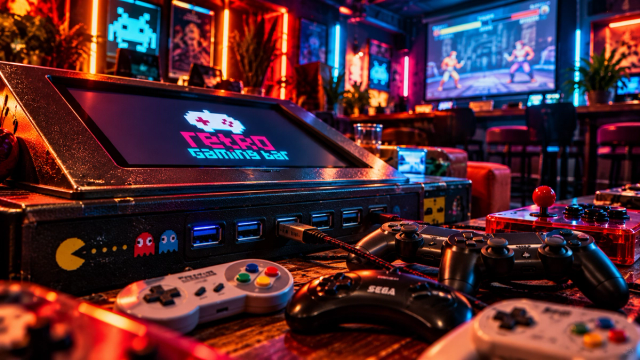
With the prototype behind us, we continued refining the design until we arrived at the version we were finally happy with. The final technical drawings brought together everything we'd learned: the raised screen structure, practical dimensions, accessible construction, supporting frame, and the distinctive shape that now defines our gaming tables. Then came the final renders. I remember seeing the completed concept and feeling that wonderful mixture of excitement and relief. After so many attempts, we finally had something that looked the way I'd imagined, worked the way we needed, and could actually be built. And when the finished tables eventually arrived at Retro Gaming Bar, the whole journey finally made sense. What began as an embarrassingly basic sketch had become the centerpiece of our entire venue. Today, we have eleven custom-built RGB gaming tables, designed around the experience we wanted customers to have from the very beginning. They aren't simply stands for screens and controllers. They're places where friends sit together, challenge each other, share a drink, argue over games, celebrate victories, and occasionally refuse to accept that they've just lost to someone who hasn't touched a controller in twenty years. Exactly what I'd hoped for.
Why We Went Through All This Trouble
Looking back at the development process, I sometimes wonder whether we could have made things easier. We probably could have bought existing furniture, installed some monitors, connected a few controllers, and called it a retro gaming bar. It would certainly have saved time. It might even have saved money. But I don't think it would have created the experience I wanted. Every iteration of the RGB table was an attempt to solve something: improve comfort, make the screens more visible, simplify maintenance, create a stronger structure, or simply make the furniture feel like it belonged in the environment we were building. Some iterations were improvements. Others were lessons in what absolutely not to do. And a few probably existed solely to remind me that knowing what you want doesn't automatically mean you know how to build it. But that's always been the philosophy behind Retro Gaming Bar. We don't want to do something merely because it's possible. We want to do it as well as we reasonably can, because the people who come to enjoy it deserve that effort. Which brings me back to that dinner table in 2015. I still remember being asked whether my little retro gaming project would ever make money. At the time, the answer was simple: I didn't know, and I didn't particularly care. I was having fun creating something. More than a decade later, that same curiosity has grown into eleven gaming tables, a collection of hundreds of games, and a place where people come together to share experiences. Whether that original hobby was a sensible financial investment is still not the question that matters most to me. What matters is seeing people sitting around those tables, laughing, competing, and enjoying something we worked so hard to create. That's the return I was hoping for all along. And to think it all started with a rather questionable drawing.
Take a look at the gallery below to see how the RGB gaming table evolved, from the first sketch to the finished product.
RGB Gaming Table Progression
Keep Exploring
How Our First Quiz Disaster Became One of RGB's Best Features
From a borrowed speaker and a room full of confused spectators to quizzes displayed on every gaming table. Sometimes embarrassment is a surprisingly effective development strategy.
Four Players, Twenty Pages of Documentation, and One Man's Descent Into Madness
How an innocent idea to let four friends play together turned into one of the most complicated projects in Retro Gaming Bar's history.
Bring Your Own Controller — How One Crazy Tournament Changed RGB
Sometimes the best upgrades come from the worst headaches.