
How Our First Quiz Disaster Became One of RGB's Best Features
From a borrowed speaker and a room full of confused spectators to quizzes displayed on every gaming table. Sometimes embarrassment is a surprisingly effective development strategy.
Our First Quiz. What Could Possibly Go Wrong?
When we decided to introduce quiz nights at Retro Gaming Bar, I thought we had most of what we needed. We had a venue full of screens, a sound system, two large televisions, and plenty of people who enjoyed a good competition. Surely organizing a quiz wouldn't be that complicated. You should probably know by now that whenever I use the word surely, something terrible is about to happen. Our first quiz was entertaining enough, but the technical execution was an absolute disaster. We'd managed to distribute the video signal to both televisions, which felt like an achievement at the time, but getting the sound working properly was another matter entirely. Our existing audio setup wasn't equipped to mix microphone input with the regular audio. We could switch to the microphone, but doing so meant losing the other sound. Mixing both together was apparently a concept from some advanced civilization we hadn't yet discovered.
In the end, we had to use an external speaker borrowed from the neighboring bar, Barbarosa. Huge thanks to its owner, Iordan, who helped save the evening. Without that speaker, things could have been considerably worse. But the sound was only half the embarrassment. Our gaming tables were designed for people to sit comfortably and enjoy their games, including three more secluded booths with doors that offer a little extra privacy. They're extremely popular with guests who prefer their own space, but during the quiz, those same guests had a rather serious problem.
They couldn't see what was happening on the televisions.
So there we were, organizing a quiz in a venue containing twenty gaming screens and two televisions, yet somehow failing to make the questions visible to everyone. Outstanding work.
The Conversation That Changed Everything
After that evening, I had a rather difficult conversation with our Event Manager. The quiz itself had been enjoyable, but the technical experience was nowhere near the standard we wanted for RGB. We agreed that we wouldn't organize another quiz until we'd fixed the problems properly. The audio issue had a fairly obvious solution, even though I knew practically nothing about audio mixers at the time. We'd have to learn how to combine microphone and music signals and integrate everything into the bar's sound system. But the visibility problem was more interesting. We could try rearranging the televisions, moving people around, or asking everyone to develop the ability to see through furniture. None of those seemed particularly appealing. Then, during what I can only describe as our post-quiz session of mutual disappointment, our Event Manager suggested something brilliant.
Why don't we show the quiz on the gaming tables themselves?
I looked around at all those screens and realized she was absolutely right. We had twenty gaming displays sitting right in front of our customers. Why were we trying to make everyone look across the room at two televisions? I had absolutely no idea how to make it work. But I was convinced it should be possible. And as we've established by now, that's usually where my problems begin.
Twenty Screens. One Quiz. Several Sleepless Nights.
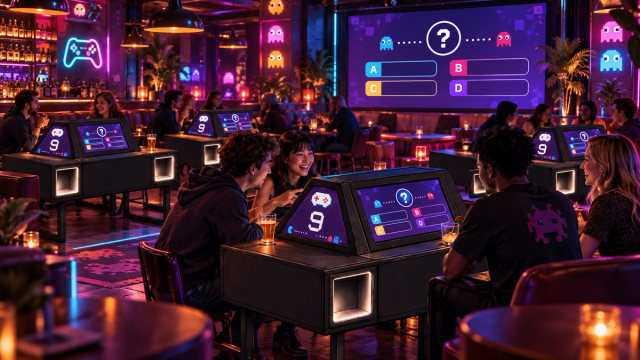
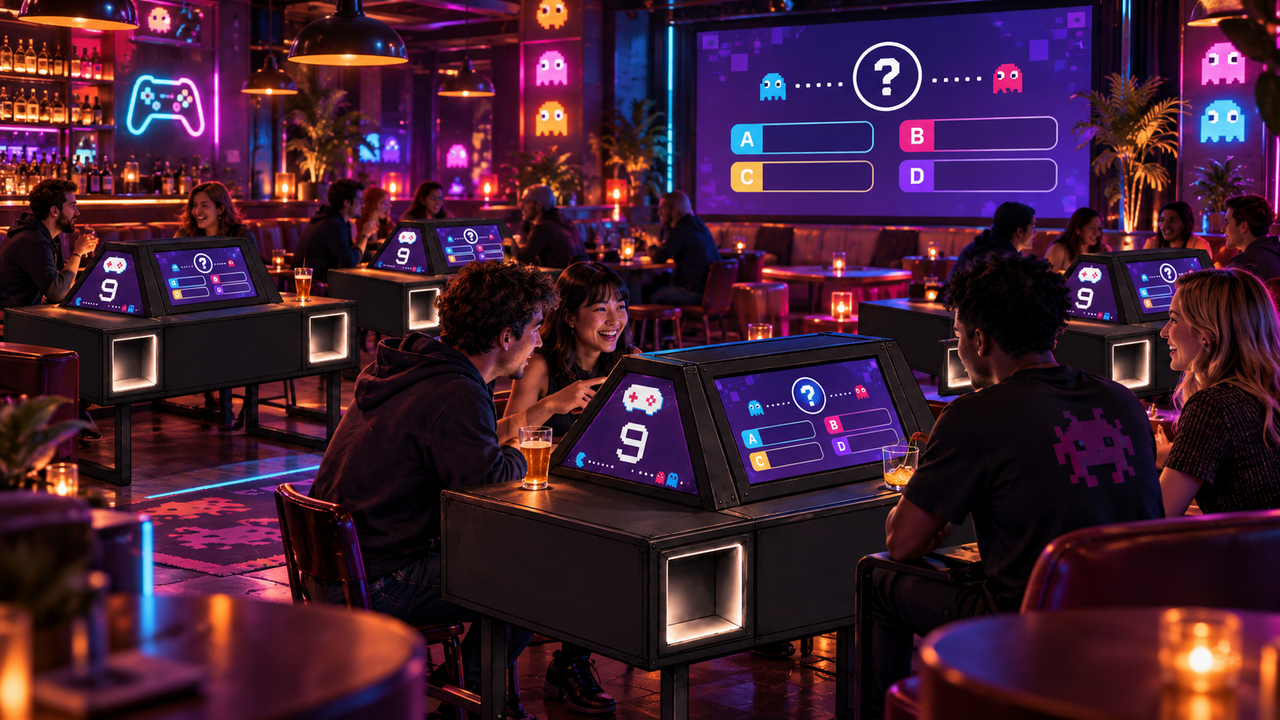
The concept was simple. Instead of forcing everyone to watch the quiz on the televisions, we would send the same video directly to every gaming table. Each team would have two screens immediately in front of them. Guests in our private booths would enjoy exactly the same visibility as everyone else, and nobody would have to twist around in their seat to follow the questions. Once our projector joined the setup later, we'd have an entire venue full of displays showing the same event. In my head, it was beautiful. In reality, our gaming tables had been designed to run video games, not to receive and display live video streams from another computer. So I started experimenting. I needed to figure out how to broadcast the quiz efficiently, how to make the gaming tables receive it, and how to avoid overloading the hardware in the process. Video resolutions, processing requirements, network traffic, software compatibility, controller input — suddenly, everything mattered. The computer responsible for broadcasting couldn't be allowed to overheat or struggle, and the gaming tables needed to display the video smoothly without sacrificing their primary purpose. What followed were countless tests, adjustments, and late nights trying to find the right balance. And eventually, we had a working proof of concept. The quiz was appearing on our gaming tables. Now we just needed to make the whole thing behave like an actual feature instead of a fragile technical experiment. Which, naturally, became another project.
The Birth of RGB Apps
I didn't want our staff to launch complicated software or manually configure individual tables every time we hosted a quiz. If we were going to introduce something new, it had to feel like a natural part of RGB. That's how RGB Apps was born. Until that point, our gaming tables had essentially one job: run games. Now we were creating a separate category of applications that could operate inside the same system. Our first application was called RGB Private TV. The idea was to make watching the quiz as easy as launching any game. Guests could open the RGB Apps collection, select the quiz stream, and watch the questions directly on their gaming table. But I wanted one more thing. What if someone wanted to play a game during the break? Rather than locking customers into a video stream for the entire evening, we designed the application to integrate with our existing controls. You could leave the quiz, return to the game collection, play something while waiting for the next round, and then launch the quiz again when it resumed. All through the same familiar gaming interface. This was the moment when I realized we weren't simply solving the quiz problem anymore.
We had taught our gaming tables to do something other than play games. And that opened up a completely new world of possibilities.
The Only Quiz Where You Can Play Contra During the Break
Today, the experience is wonderfully simple. You sit down with your team, order your drinks, and follow the quiz directly on the screens in front of you. No awkward viewing angles, no struggling to see questions across the room, and no disadvantage for the guests sitting in our more secluded booths. Every team has two screens available, making the entire experience feel much more personal and comfortable. And when there's a break between rounds? Well, you're at Retro Gaming Bar. Why not play a quick game of Contra? Finish your little gaming adventure, switch back to RGB Private TV, and you're ready for the next round. To my knowledge, there isn't another quiz experience in Bulgaria offering quite this combination. I certainly haven't encountered another venue where teams can switch between a live quiz broadcast and a full retro gaming collection directly from their tables. What began as a desperate attempt to make our questions visible to everyone had become one of my favorite features of the bar. And our guests loved it.
Content from TikTok is disabled.
Enable it in - Cookie Settings
One Improvement Opens the Door to Another
Here's the part of the story that I find particularly satisfying. When we started developing RGB Private TV, we didn't have most of the audiovisual infrastructure that RGB uses today. We weren't streaming our tournaments on Twitch, our projector wasn't integrated into the system, and our gaming tables had never been used as general-purpose video displays. But by solving one problem properly, we created the foundation for several future improvements. Once the tables could receive live video, the source of that video no longer had to be a quiz. It could be tournament footage, another event, or something entirely different. That knowledge eventually became useful when we began developing our tournament streaming infrastructure and integrating the projector, televisions, and gaming tables into a much more flexible entertainment system. And RGB Apps itself didn't stop with Private TV. We also introduced a menu application, allowing customers to browse our bar menu directly through the gaming tables. Something that would have seemed like a completely separate technical project suddenly became much easier because we'd already built the foundation. I love that about developing RGB. One improvement creates opportunities for another, and sometimes a decision made to solve a very specific problem turns out to be valuable in ways we hadn't anticipated. We had chosen flexible hardware when building the tables, and this project was one of the first major demonstrations that those early decisions were paying off.
And What About the Sound?
Ah, yes. The sound. While all this video-streaming madness was happening, we still had to fix the original audio problems. So we learned about mixers, audio inputs, signal routing, and how to combine microphone and music without making one disappear whenever the other was active. I realize that anyone with basic audio engineering experience is probably laughing at this point. Yes, we learned how to mix two audio channels. Please hold your applause. But for people who initially had to figure out what a patch cable was, this was quite the educational journey. Eventually, we integrated the microphone and other audio sources into the bar's sound system properly. And just like the video infrastructure, those improvements later became essential for our tournaments, live streams, and other events. Another problem solved. Another piece of the bigger picture in place.
From Our Worst Quiz to Something Truly Special
Looking back, I'm actually grateful that our first quiz went so badly. Not particularly grateful while it was happening, of course. At the time, I would have preferred a functioning microphone and significantly less embarrassment. But that evening forced us to rethink what a quiz at Retro Gaming Bar could be. We could have solved the immediate issues with another television, a few speakers, and some rearranged furniture. Instead, we turned our gaming tables into live video receivers, created an entirely new application system, and laid the foundations for future upgrades that we continue to use today. All because our Event Manager asked one wonderfully simple question:
Why don't we show the quiz on the gaming tables?
Sometimes the best ideas don't come from months of planning. They come from realizing that what you're doing isn't good enough and refusing to settle for a mediocre solution. Today, our quizzes are one of the experiences that make RGB special. You can gather your friends, challenge your knowledge, enjoy the atmosphere, and follow every question comfortably without leaving your gaming table. And if the next round hasn't started yet, there's always time for a little retro gaming.
After all, we didn't build twenty gaming screens just to make everyone stare at the television.
You now know why
Keep Exploring
Back to the 90's with QuizNight - January 2026 Edition
Memory Lane Has No Speed Limit!
Photo Quiz with Atanas Atanasov - October Edition
A picture is worth a thousand words… but can you find the right answer?
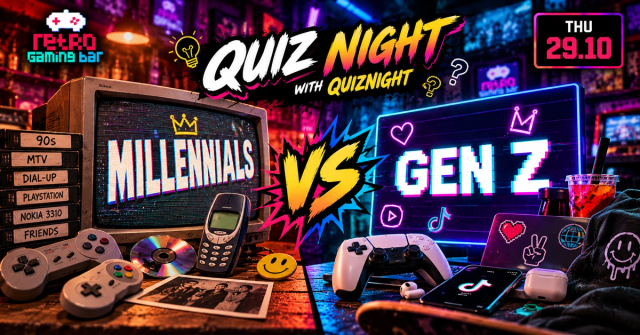
Millenials VS. Gen Z - October Edition
Two generations. Two completely different childhoods. One ultimate showdown!