

Four Players, Twenty Pages of Documentation, and One Man's Descent Into Madness
How an innocent idea to let four friends play together turned into one of the most complicated projects in Retro Gaming Bar's history.
Four Controllers. How Hard Could It Be?
When we first designed the gaming tables for Retro Gaming Bar, I already knew I wanted them to support four players simultaneously. In fact, we designed the tables with four control ler slots from the very beginning. The ambition was there, the physical space was there, and I had a pretty clear picture of four friends sitting together, enjoying the classics just like we used to. What I didn't have was the time, the infrastructure, or even a remotely realistic understanding of what implementing it would involve. Much like our signature cocktails, four-player gaming was one of those ideas that simply couldn't make it into the bar before opening.
Content from TikTok is disabled.
Enable it in - Cookie Settings
Then the doors opened, daily operations took over, and the entire first year became an exercise in survival. We were running tournaments, improving our systems, solving unexpected problems, and learning how to operate a bar. Starting another enormous technical project wasn't exactly high on my priority list. Besides, we weren't ready for it. We still needed to redesign how our controllers worked, introduce interchangeable controller profiles, bring the USB connections outside the tables, and eventually develop our Bring Your Own Controller system. Then came the projector and the big screen, partly because our increasingly popular tournaments needed a way for spectators to watch without gathering around the players like a medieval crowd witnessing a public execution. But the projector had another purpose. One day, when four-player gaming finally became a reality, I wanted everyone to be able to enjoy the action on the big screen. And gradually, all those seemingly separate projects began falling into place.
The Dangerous Confidence of Knowing What You're Doing
After completing BYOC and rebuilding our controller infrastructure, I felt pretty confident. I'd spent countless hours learning how our software handled controllers, profiles, connections, and input mapping. I'd even made decisions with future upgrades in mind.Surely, with all that experience behind me, adding four-player support would be manageable. I could not have been more wrong. If BYOC was complicated, four-player support was BYOC multiplied by ten. Not only in technical complexity, but in the sheer variety of problems waiting to be discovered. And there was another issue: time. I've always said that my brain works a little like RAM. I can load a complicated project into memory, fill it with technical details, dependencies, and potential solutions, and work through it. But eventually, the memory is full. When another urgent problem appears, I have two choices: ignore the new task or clear the existing one to make room. Running RGB rarely gives me the luxury of ignoring urgent problems. So several times during this project, I had to put everything aside, deal with more pressing matters, and return weeks later to discover that my brain had helpfully forgotten half of what I'd learned. Imagine solving a complicated puzzle, putting it away for a month, and coming back to find that someone has removed all the pieces and replaced the instructions with ancient Egyptian hieroglyphics. That was roughly my development process.
The First Mistake: Thinking Two USB Extensions Were Enough
Naturally, I began with the simplest possible approach. Critical path, low-hanging fruit, one problem at a time. All the respectable project-management principles I like to tell myself I follow. The first step was obvious. We already had two controllers working, and the tables already had four physical slots. All I needed were two more USB extensions. Easy. I ordered them, went to the bar, and discovered that connecting four controllers properly required additional specialized equipment and a rather more complicated arrangement than I'd anticipated. Excellent start. At that point, I realized that making repeated trips to the bar just to discover another reason why something didn't work was going to drive me insane. So I brought one of our vertical gaming tables home and turned it into my personal development laboratory. This was probably the smartest decision I made during the entire project. At least now, when something failed spectacularly, I could shout at the table without disturbing our customers. I'll spare you the technical details of how we solved the hardware challenges. Some of those solutions are part of RGB's proprietary setup anyway. But let's just say that reliably handling four simultaneous controller connections was nowhere near as straightforward as plugging in four cables. By the time everything was finished, the documentation explaining how to reproduce the setup had grown to twenty pages. Small font. And that's the version where I tried to be concise.
The First Victory. Or So I Thought.
After several months of work, I finally had a proof of concept. Four controllers. One game. Everything working beautifully. The game was Crash Team Racing on the original PlayStation, and watching four players function simultaneously felt like a major breakthrough. I was so pleased that I announced the achievement in our Discord community. The proof of concept was ready! We were getting close! Looking back, I was closer to losing my sanity than to completing the project. You see, the PlayStation was one of the more advanced systems in our collection. Multiplayer accessories were already relatively mature by that generation, and I assumed that if I could make four controllers work in Crash Team Racing, the hardest part was behind me. That assumption lasted approximately until I started testing other games.
Welcome to Multitap Hell
For anyone unfamiliar with the technology, a Multitap was an accessory that allowed older consoles to connect more controllers than their standard ports supported. In theory, it was a brilliant invention. In practice, different consoles, games, and accessories had their own ideas about how everything should work. And apparently, nobody had bothered to agree on anything. Take International Superstar Soccer 2 on the PlayStation, for example. You might reasonably expect the first connected controller to be Player 1, the second to be Player 2, and so on. How adorable. Instead, the game expected a peculiar arrangement where Players 1, 3, and 4 were connected through the Multitap on the first port, while Player 2 occupied the second port. Now remember that I'd just spent months building a beautiful controller system where each physical connection reliably corresponded to its assigned player. Suddenly, I needed the second controller connected to our table to appear somewhere entirely different inside the game. I had become an expert in controller profiles. Apparently, I now needed to become an expert in convincing thirty-year-old video games that reality was optional. Eventually, I solved it. I don't remember much of those months, and I'd rather not investigate why. But the real discovery was that there wasn't a universal solution. Every game could behave differently. Some needed specific Multitap ports, others expected unusual controller assignments, and a few seemed determined to test the limits of human patience. There is still one particular hockey game that refuses to cooperate. I've decided to let it win. We have other four-player hockey games, and frankly, I'd rather remove the problematic one from the collection than spend another week negotiating with it.
Sega Mega Drive: Hold My Beer
After finally getting PlayStation multiplayer working, I thought we could move on to the older systems and finish the job. I was experiencing what psychologists call the Dunning–Kruger effect, although at the time I simply called it making progress. Because if you think PlayStation Multitap configurations are complicated, I invite you to explore four-player gaming on the Sega Mega Drive.
I dare you.
This was an era when multiplayer accessories were still something of an experiment. Different manufacturers created different adapters, each with its own way of connecting and identifying controllers. There were several competing Multitap standards, and some games even used special J-Cart cartridges with additional controller ports built directly into the cartridge itself. Naturally, none of this translated into one convenient setting. So what began as adding four-player support turned into a complete rework of how Mega Drive games operated on our tables. And then came the testing. Some games claimed multiplayer support but only offered hot-seat gameplay, where players take turns using the same controller. Others required very specific configurations. Some appeared to support four players but behaved differently depending on the game version. You could spend two days trying to make a Multitap work, only to discover that the game never needed one in the first place. Wonderful.
Six Hundred Games. One by One.
By this point, the project had become considerably larger than the original idea.
I couldn't simply enable a feature and hope everything worked. We needed to investigate our collection, understand which games genuinely supported simultaneous multiplayer, identify their requirements, and configure each compatible title properly. And that meant reviewing our library of more than 600 games.
One by one.
PlayStation. Mega Drive. SNES. NES. Different platforms, different controller systems, different multiplayer conventions, and an apparently endless supply of surprises. Every platform introduced its own peculiarities. Every time I thought I'd finally understood how one system worked, another game would happily demonstrate that I hadn't. Then there was Bomberman.
Oh, Bomberman.
I spent an unreasonable amount of time trying to understand why certain games would recognize three players but stubbornly refuse to acknowledge the fourth. Three controllers working perfectly, the fourth sitting there like an unwanted guest at a birthday party. I have developed a personal grudge against some of these games. So if you ever wonder why we don't have every possible Bomberman title in our collection, now you know. It's not necessarily because I don't like Bomberman. It's because Bomberman and I have unresolved issues.
The Day I Unplugged Player Three
Eventually, after countless hours of testing and reconfiguration, the games were working. Surely this was it. Surely I could finally declare victory. Then, one day, I accidentally unplugged the third controller. And the fourth controller became Player 3. I nearly cried. Actually, I think I did cry a little. Because I knew exactly what that meant. Our controllers were being assigned based on their connection order, and disconnecting one could cause the others to shift positions. For a home gaming setup, that might be a minor annoyance. For a bar where customers constantly connect, disconnect, and swap controllers, it was unacceptable. Imagine four people playing a tournament match, somebody accidentally disconnecting a controller, and suddenly Player 4 starts controlling Player 3.
Chaos.
I stared at the table, contemplating my life choices, and began expressing my frustration in a language that probably predates recorded human civilization. Fortunately, the table was still at home. Another major development project followed. This time, I had to make player assignments remain stable regardless of which controllers were connected or disconnected. Physical ports, controller identities, mapping assignments, and Multitap configurations all needed to cooperate. Eventually, they did. BYOC Expert — Level 2 Unlocked. I was now mapping controllers and player positions across dimensions I hadn't even known existed when I started.
One Final Problem. Naturally.
With stable controllers and compatible games, we were finally ready to let customers enjoy four-player gaming. Except there was one more problem. Our game metadata wasn't always accurate. A game might support four players perfectly, but if our collection database incorrectly listed it as a two-player title, customers wouldn't know it was available. Which meant that all the effort we'd spent implementing four-player support could be undermined by something as ridiculous as an incorrect number. You know w
hat comes next. Back through the collection we went, reviewing and correcting player counts, checking game information, and making sure the available multiplayer experiences could actually be discovered. Then we created a dedicated Show Multitap Games collection in our gaming interface, along with further adjustments to how the tables presented the games. At this point, I was no longer surprised that enabling four-player gaming had required redesigning half the systems our tables used. The first time, it's funny. After the fifth major overhaul, it becomes a lifestyle.
Four Players. Three Tables. One Very Tired Founder.
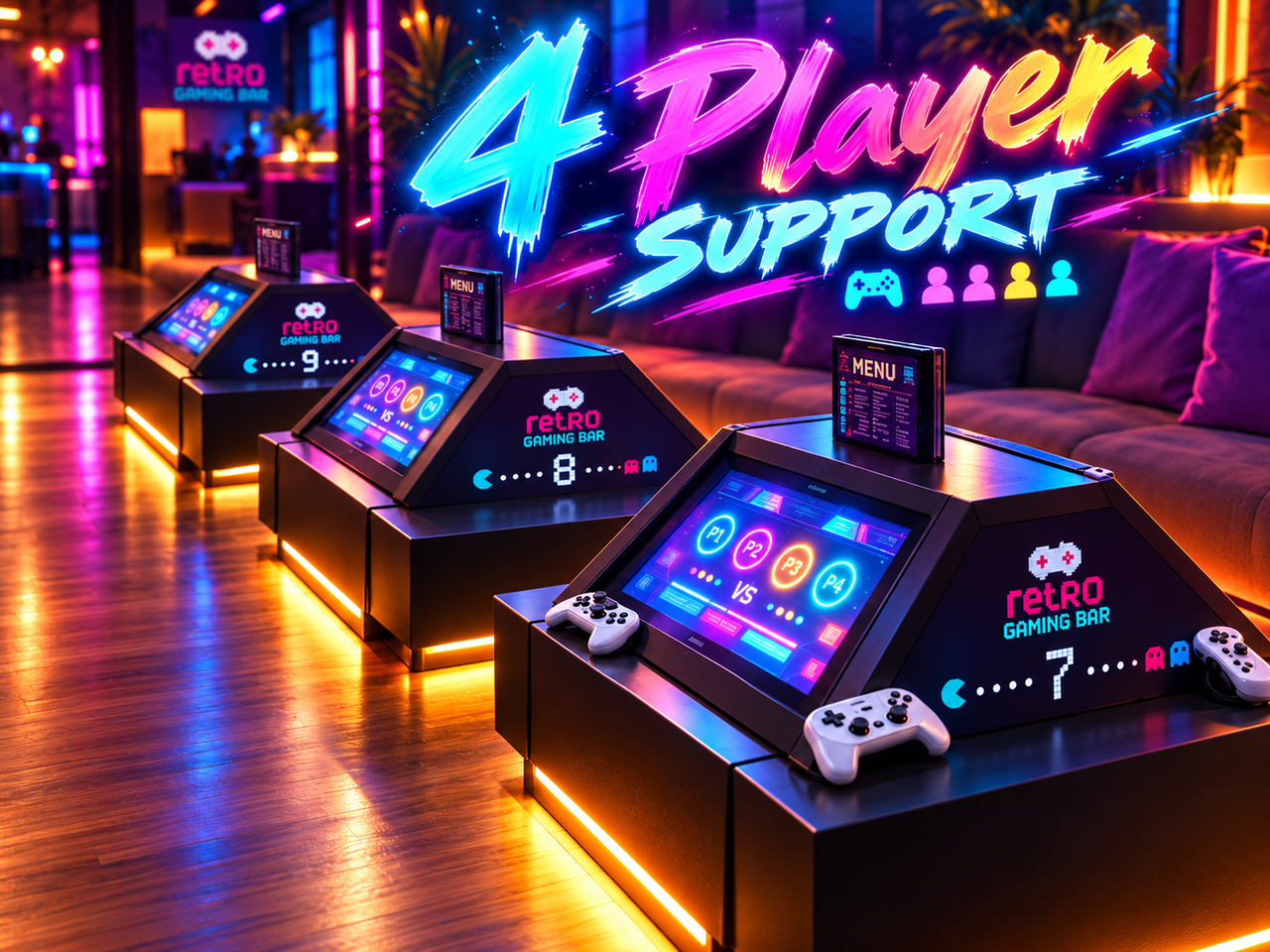
Today, Tables 7, 8, and 9 at Retro Gaming Bar support four-player gaming, opening up a fantastic collection of multiplayer experiences for friends, families, and tournament participants. From racing together in Crash Team Racing to battling in Bomberman, competing in sports games, or discovering classic cooperative adventures, four players can finally share the same gaming experience. We've also integrated these tables with our projection system, so the action can move onto the big screen for everyone to enjoy. And the best part? For our customers, it really is as simple as sitting down, picking a game, and playing together. That's exactly how I wanted it to be from the beginning. Of course, there's one question I occasionally get:
Why do only three tables support four players? Why not all ten?
Well, now you know. The technical process is documented, and theoretically, expanding the setup is much easier than developing it from scratch. Unfortunately, enough time has passed that I've cleared most of that knowledge from my mental RAM again. At least I have twenty pages of documentation explaining how to do it. Small font, remember?
So perhaps one day we'll expand four-player support to more tables. But for now, I think I'll enjoy the fact that this project is finally finished.
Four friends. Four controllers. One game. How hard could it possibly be? Please don't answer that.
Keep Exploring
Bring Your Own Controller — How One Crazy Tournament Changed RGB
Sometimes the best upgrades come from the worst headaches.
All 4-Player Games
We have more than 50 multitap games ready for you to explore.

RGB League Season 2 — Bigger, Bolder, and Full of Experiments
Eight tournaments. More games, new competitive formats, and one spectacular season finale still to come.