

Fisherman's Bait: A Bass Challenge

Fisherman's Bait brings the simple fishing gameplay of the original arcade title to the Playstation. Reel in 6 different fish like the Rainbow Trout and Largemouth Bass using 7 kinds of lure. Once you get a bite, drag your catch by pressing buttons in alternating fashion. Challenge Tournament mode and catch as many fish as you can in the set time limit!

Meta

RGB Live data

Total times played
86
Total hours played
09:43

Refresh Your Memory

Content from YouTube is disabled.
Enable it in - Cookie Settings

Open it in YouTube

Keep Exploring

Olympic Summer Games

Olympic Summer Games

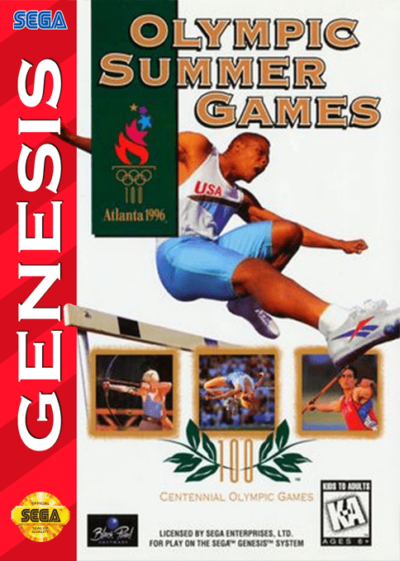
Olympic Summer Games is the 16-bit official videogame of the 1996 Olympic Games held in Atlanta, the third and the last IOC official title to be released on the console. A typical button masher, includes 10 events (100m sprint, 110m hurdles, pole vault, long jump, triple jump, javelin, high jump, discus, skeet and archery) and 32 countries around the world compete in custom or full Olympics, or just practice. Two players can compete head to head in the sprinting events, and a total of eight can play in the same game. Three difficulty levels allow competitive events for both rookies to veterans in the genre. Sprinting events are a short and straight button mashing frenzy. 4 athletes compete simultaneously, the first winner advancing to the next round (two qualifiers and then the medal run). Only fast fingers and quick shotgun reaction can earn world record times. Jumping events are a mix of shorter button mashing bursts combined with timely pressed jumps. From the straight forward high and long jump events (run and then set the jump angle) to the more elaborate triple jump (as the name suggests, three jumps must be carefully measured for world class results) and the complex pole vault, where a strong run must be followed by a sharp pole fixation and good a release upwards. Both long jump and triple jump have a first round composed by three jumps, the better eight progress into the second round, where they are given three more jumps. In the high jump and pole vault the competition continues until all athletes miss three consecutive jumps. The throwing events (discus and javelin) work in the same fashion as the jumping events, although trickier to pull, as the setting of the angle must be followed by a timely release. Each player is entitled to three throws, the top eight allowed three more attempts. Finally, the shooting events. Archery is a three-round competition where the goal is to amass as many points as possible by shooting at the inner rings of the target. With six arrows per round, each shot must be calculated according to the wind, choosing between steady aim and lower tension (must be aimed upwards and compensating the wind) or higher tension but a jumpy aim (can be aimed directly at the "gold" points). Skeet is a five round competition where the goal is to hit five clay pigeons before they disappear off-screen with two slugs for each.
Speedball 2 : Brutal Deluxe

Speedball 2 : Brutal Deluxe

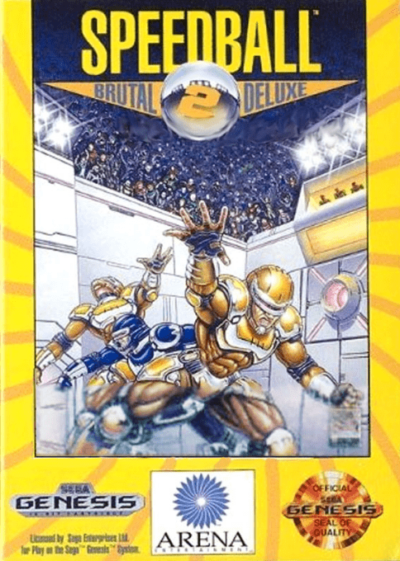
Brutal Deluxe doesn't live up to their name - in fact they're the worst team Speedball has ever seen. As their manager, it is your job to transform their fortunes. As well as the league system, which consists of 2 8-team divisions and challenges you to advance to the top, there are also 2 cup tournaments, one of which is played out over 2 'legs' with the aggregate score deciding who progresses. You can play the matches as well, which is the real meat of the game. They consist of 2 90-second periods, and the gameplay is futuristic, fast and frantic, with heavy tackling encouraged to retrieve the ball. Power-ups and tokens appear on the pitch, including ones to make your players extra-tough or freeze the opponents. The sides of the pitch each include a score multiplier, which you can run the ball through to increase the value of your scoring - the opposition can sometimes immediately grab the ball and nullify this. There are also 5 stars which are worth 2 points each if you hit them (more if you have the multiplier activated), but these can also be cancelled out by the opposition hitting the same star, and their points values only become set after the half. Next to the stars there are 'portals' which throw the ball out the opposite side of the pitch, in the direction it was going. You get money for the results, and by collecting the silver tokens which appear on the pitch at random intervals. Between each match you can spend these either on improving your existing players as far as they can go, or on buying better ones and fitting them into the team. Your original players can only be improved to a certain extent, so remembering where your signed players are and making use of them is important. A variety of tokens also appear during the match, some of which boost your team's power for a short period of time, and one freezes the opposition.

FIFA International Soccer

FIFA International Soccer

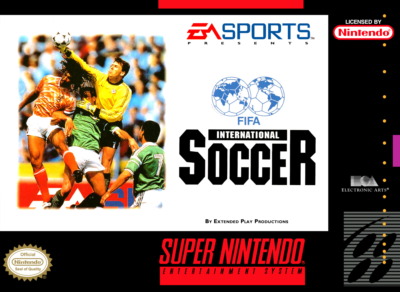
The game that started the best-selling series licensed by football's world governing body, this first installment in the long running series used a dimetric (colloquially known as "isometric") viewpoint, previously unusual in football games but quickly imitated by several titles. The televisual presentation, one of the unique points of the early EA Sports titles, with hosts introducing the matches, was another thing making the game stand out from a market dominated by Sensible Soccer and Kick Off games. Based on international teams (with fictional player names), their abilities in each skill area rated out of 10 to give the player an overall impression of how good they are. The options available follow the standard set: fouls and offsides can be toggled on and off, the match length can be set, and if the timer operates continuously, or only while the ball is in play. Gameplay privileges quick runs, short passes and blistering shots outside the penalty box, and set pieces are controlled by moving a box into the target area for the ball, and then passed, lobbed or kicked directly. On the tactical side, formations can be selected, with 5 different strategies also available (although not all of these combinations make sense) as can the team Coverage - the areas which defenders, midfielders and strikers cover.