
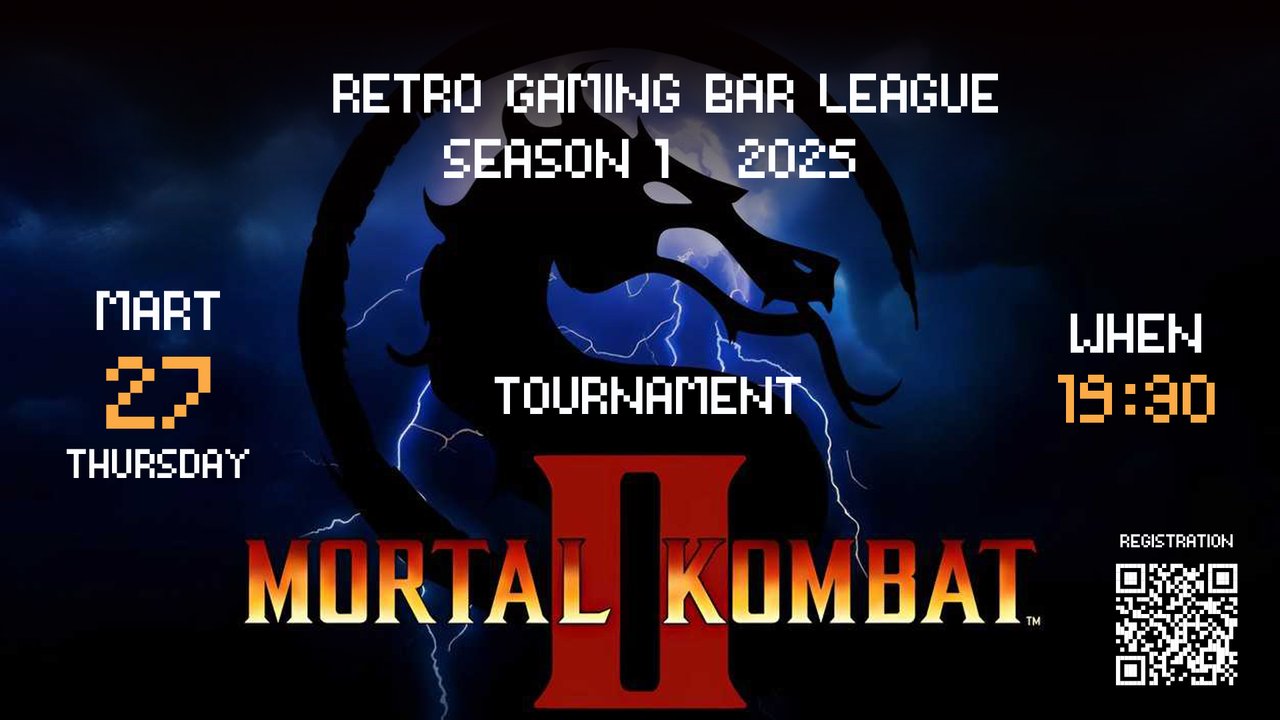
RGB League 2025 - Mortal Kombat II: The Tournament That Changed Everything
Our very first RGB League tournament. One legendary fighting game, a mountain of technical problems, and a reality check we'll never forget.
Every Legend Has an Awkward Beginning
Content from YouTube is disabled.
Enable it in - Cookie Settings
If you've attended one of our recent RGB League tournaments, you've probably experienced the big-screen action, live streaming, dedicated tournament playlists, custom controller configurations, and the organized competition we've spent so much time developing. Well, let me tell you how it all started. With Mortal Kombat II on the Sega Mega Drive and a tournament that, from my perspective, was an almost complete disaster. There's a wonderful Bulgarian expression, „като в небрано лозе“, which roughly describes finding yourself in a situation where you have absolutely no idea what you're doing. I don't think there's a perfect English equivalent, but that's exactly how I felt during our very first tournament. Our community had been encouraging me to organize competitive events for quite some time. Unfortunately, during RGB's first year, I was completely buried under the administrative and operational challenges of running a newly opened bar. There were countless things demanding my attention, and organizing tournaments was yet another enormous task waiting in line. But eventually, I found the energy to give it a shot. I'd managed to figure out our sound system and mixing equipment, updated our old static HTML website to introduce the RGB League concept, learned how to use Challonge, and prepared the tournament brackets and rules. Considering everything else happening at the time, that felt like quite an achievement. And technically, we were ready. Or so I thought.
Welcome to the Chaos
Imagine me standing in front of our participants with a microphone, enthusiastically trying to explain the RGB League concept and tournament rules. There was just one minor problem. I could barely remember what a single-stage, double-elimination tournament actually meant. I'd spent so much time preparing the technical and administrative side of the event that when the moment came to explain everything to actual human beings, my brain apparently decided it had fulfilled its contractual obligations and could take the rest of the evening off. And that was only the beginning. For the soundtrack, I had what seemed like a brilliant idea: let's play the original Mortal Kombat II music throughout the tournament! Very atmospheric. Very authentic. Also, as we gradually discovered, not necessarily the ideal soundtrack for an entire evening of competitive gaming. That experience eventually led us to experiment with different musical styles and build our dedicated tournament playlists, including the powerful nu-metal selection that has become a favorite among our participants. We also started creating additional playlists for other events, something that ultimately benefited the entire bar. But music was probably the least of our problems that night.
Controllers, Shortcuts, and Other Fatalities
Today, one of the things we're particularly proud of is our extensive controller support. Players can use different supported controllers, bring their own devices, and benefit from configurations we've developed through countless hours of testing. Back then? We had practically none of that. No proper controller profiles. No external USB extensions. No convenient way to switch between different controller setups. Even the distinction between three-button and six-button Mega Drive configurations wasn't properly implemented. And Mortal Kombat II was about to demonstrate why that mattered. Our eventual champion preferred playing with a three-button configuration, using Start for blocking. Unfortunately, our controller setup also used button combinations for global emulator shortcuts, meaning certain inputs could accidentally exit the game. Which is not exactly something you want happening in the middle of a competitive Mortal Kombat match.
Our improvised solution was to make him play as Player 2 to reduce the risk of accidentally triggering the exit shortcut. Yes, you read that correctly. We had to accommodate the eventual tournament champion by assigning him a particular player position because our controller configurations weren't ready for competitive play. And that was just one of several controller-related problems we encountered. This tournament became one of the earliest turning points in the long development journey that eventually gave us proper controller profiles, separate three-button and six-button configurations, external USB access, and the much more flexible controller system we use today. We simply couldn't afford to leave these problems unresolved.
The Final That Almost Nobody Could See
Then there was the small matter of actually watching the matches. Today, our tournaments feature a dedicated projector and big screen, allowing everyone to follow the action without disturbing the players. During our first tournament, none of that existed. Spectators gathered directly around the gaming tables, trying to get a better view of the matches. Unfortunately, this also meant crowding the competitors, who were doing their best to concentrate while people stood practically over their shoulders. It was obvious that we needed a proper way for the audience to watch the action. And naturally, we didn't have live streaming either. No Twitch broadcast. No YouTube highlights. No dedicated capture equipment or tournament production setup. For the grand final, we simply grabbed a mobile phone and recorded the match because we wanted at least some footage for our archive. That humble recording eventually helped motivate the development of our entire streaming infrastructure, which now allows us to broadcast tournaments live on Twitch and share highlights on YouTube. It's almost funny to think how much of our current technical setup can be traced back to that evening. Almost. At the time, I wasn't laughing very much.
Our First RGB League Champions
Despite everything happening behind the scenes, the competition went ahead, and we crowned our very first RGB League tournament champion.
Congratulations to our first champion, Mitko, who finished the tournament undefeated with a 4–0 match record, and to everyone who participated in this inaugural event!
- Rank: 1Player: mitcoivWins: W W W W
- Rank: 2Player: DobretenovWins: L W W W W L
- Rank: 3Player: BurnedeadWins: W W L L
The Reality Check We Needed
When the evening finally ended, I wasn't particularly happy with myself. In fact, I was embarrassed. Looking back, I can admit that I was probably exaggerating how badly things had gone. After all, we'd managed to organize our first tournament, players had participated, and we'd successfully launched something completely new for RGB. But none of that changed how I felt at the time. All I could see were the problems. The awkward explanations. The controller issues. The spectators crowding the tables. The improvised video recording. The dozens of things I hadn't anticipated because I'd never organized anything quite like this before. I went home knowing that if we wanted RGB League to become something serious, we had an enormous amount of work ahead of us. So I did what I usually do when faced with a mountain of problems. I started making a plan. I identified the most critical issues, worked out their dependencies, and began charting a path toward the tournament experience I actually wanted us to deliver. We certainly weren't going to solve everything before the next tournament. Some improvements would take months, while others would eventually become entire projects of their own. But at least now we knew what needed to be done. And that was an important beginning.
The People Who Believed Before We Deserved It
Content from YouTube is disabled.
Enable it in - Cookie Settings
There's one thing I remember from that first tournament more fondly than anything else.
Our community believed in us.
While I was busy criticizing everything we'd done wrong, the players were remarkably supportive. They understood that we were attempting something new, that we didn't have all the answers, and that the experience would improve with time. They gave us something incredibly valuable: a chance to get better. That support meant the world to me. Over the years, I've occasionally had discussions with our marketing team about why I continue investing so much time and effort into tournament improvements. After all, tournaments haven't always been the most profitable events we organize, and there are plenty of other things demanding our attention. My answer has remained essentially the same.
It will become successful when we've built something that deserves to be successful.
We can't expect people to support an experience simply because we've decided to organize it. We have to earn that support by making every tournament better than the previous one, listening to feedback, fixing problems, and gradually creating something people genuinely want to be part of. That's the philosophy behind almost every improvement we've made to RGB League since that first evening. And it started with those players who came to our very first Mortal Kombat II tournament, saw all our imperfections, and decided to support us anyway.
Finish Him? Not Quite.
Today, it's tempting to look back at our first tournament and laugh about everything that went wrong. And believe me, there's plenty to laugh about. But without that evening, we might never have recognized just how much work was necessary to turn RGB League into the experience it has become. The controller profiles, streaming equipment, projector, tournament playlists, and many of our other improvements weren't created simply because we thought they would be cool additions. They were answers to real problems we discovered along the way.
Mortal Kombat II didn't just give us our first champion. It gave us a roadmap for everything RGB League needed to become.
And for that, I'll always remember it as one of the most important tournaments we've ever organized. Even if I occasionally wish I could forget how badly I explained double elimination.
Keep Exploring
RGB League Season 1 (2025) — Where It All Began
Eight tournaments. 74 players. 213 matches. One unforgettable first season.
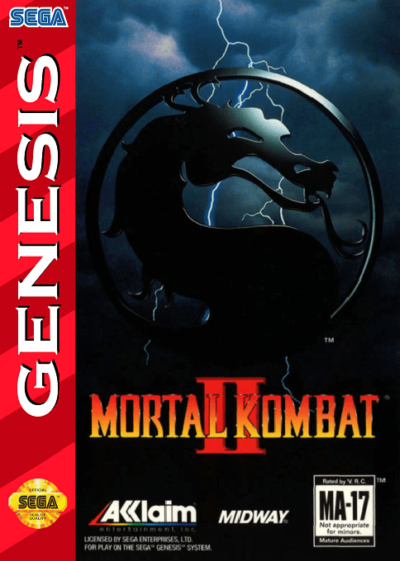
Mortal Kombat II
The Mortal Kombat fighters, plus several new ones, return for a tournament held by the evil Shang Tsung of the Outworld. The action is one-on-one as before, and famed for its high level of violence and blood (other than the sanitised Nintendo version). There are 5 difficulty levels and optional credits, as well as the usual two player mode including same character duels. To win the main tournament, the player must beat each of the other human players, before taking on Shang Tsung, Kintaro and finally Shao Kahn. Players have a range of punches and kicks available, as well as flying kicks, uppercuts, roundhouses, and the special moves, which vary for each player. These include throws, uppercuts, long-distance bullets, bicycle kicks and a teleport feature.
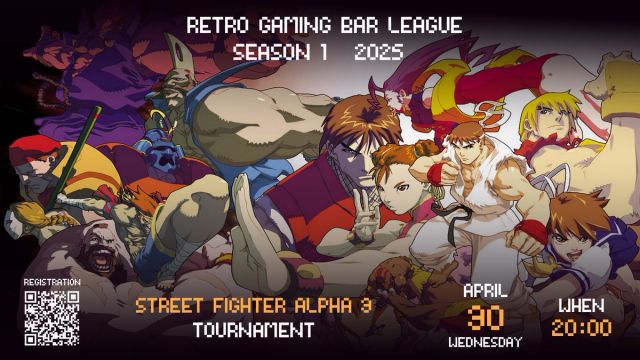
RGB League 2025 — Street Fighter Alpha 3: New Console, New Problems
Tournament #2 — April 30, 2025 | Street Fighter Alpha 3 (PlayStation)