
The Retro Living Room: How My Childhood Found Its Way Into RGB
The story of a growing video game collection, an ambitious man cave, a very persistent television expert, and the little corner of Retro Gaming Bar that means more to me than almost anything else.
No, My Wife Didn't Kick Me Out
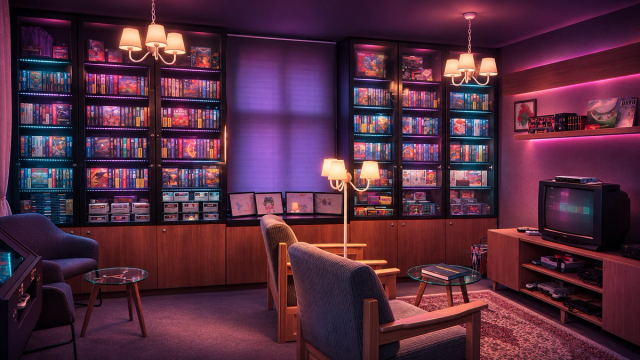
There's a story about Retro Gaming Bar that has appeared in more than a few interviews over the years. Apparently, my video game collection had grown so enormous that my wife finally told me to get it out of the house, and that's how I ended up opening an entire retro gaming bar. It's a wonderful story. Unfortunately, it's not true. My wife never issued an ultimatum, although considering the direction my collection was heading, perhaps she should have. The actual story is a little more complicated and, in my opinion, considerably more interesting. It began with something much simpler: I wanted a proper man cave. I'd been following retro gaming collectors and content creators, including Metal Jesus Rocks and the Angry Video Game Nerd, and I loved the idea of having a dedicated room filled with classic games, original consoles, shelves of cartridges, and everything connected and ready to play. My collection had been growing for years, particularly my beloved Sega Mega Drive games, and the shelves at home were gradually becoming insufficient. But it wasn't simply about storage. I wanted a place where I could actually enjoy the collection properly, invite friends over, and recreate some of that wonderful feeling of discovering video games during childhood. A proper gaming sanctuary. That was the entire plan. At least for the first five minutes.
How a Man Cave Accidentally Became a Business
The more I thought about creating this room, the more ideas started appearing. What if, instead of trying to squeeze everything into our home, I rented a small place somewhere? I could set up the consoles, display the collection, and invite friends over whenever we wanted to play. That sounded reasonable. Then I thought that perhaps other people might enjoy visiting too. After all, surely we weren't the only adults who still found old video games fascinating. At the time, I also had plenty of duplicate games in my collection. What if we made a small public gaming room with a little shop where people could buy and trade classic games? Now we were getting somewhere. Of course, if I wanted to sell games, customers would probably want to see them working before buying them. So I needed some kind of universal gaming setup where different titles could be demonstrated conveniently. Perhaps one of those multi-console solutions, like a RetroN, integrated into a specially designed table? And that's how the idea for the RGB gaming table started taking shape. But then another thought occurred to me. If one gaming table was a good idea, wouldn't ten gaming tables be even better? And surely people would want something to drink while they played. So perhaps we needed a small bar as well. And maybe a proper interior, somewhere comfortable to sit, and a few other things... You can probably see where this is going. Somehow, the perfectly innocent idea of building a man cave at home had evolved into opening an entire business. Welcome to the way my brain works. If you're curious about what happened next, our other founder stories cover the adventures of designing the gaming tables, finding the right venue, and building Retro Gaming Bar from scratch. But one part of that original dream never disappeared.
I still wanted my man cave. And this time, I was going to share it with everyone.
The First Retro Corner. Well, Sort Of.
When Retro Gaming Bar opened, we already had an area reserved for what would eventually become the Retro Living Room. Unfortunately, as with so many of our original ideas, the grand vision and the available time were not particularly well acquainted. The first version was... let's call it experimental. I'd originally imagined that I could work my regular job from the bar during the day. I would sit at a desk, do my work, and when opening time arrived, simply unlock the doors and welcome the customers. Brilliant, right? Except that designing furniture around this idea turned out to be one of the least practical decisions I made during the entire project.
The custom desk wasn't particularly convenient for gaming, and once the bar began operating properly, it had virtually no useful purpose at all. So there it was: a piece of furniture designed specifically for a plan that didn't survive contact with reality. An expensive monument to optimism. We also didn't have all the original consoles I wanted, or even the proper CRT television that was supposed to complete the experience. I was primarily a Sega Mega Drive collector, and although I had an extensive collection of games and several variations of Sega hardware, recreating an entire 1990s living room required much more than that. I should mention Todor Miroleskov, who has supported RGB since the very beginning and helped me find some of those missing pieces, including an original NES with a Zapper, SNES and Game Boy. He's effectively become my trusted retro console dealer, not to mention he is amazing electrician as well, who can fix retro stuff. The first version of the corner was still far from what I wanted, and explaining that to visitors wasn't always easy. They could see the furniture, the shelves, and the collection, but they couldn't see the finished idea that was still living inside my head. Then again, that had become a recurring theme throughout the creation of Retro Gaming Bar. The important thing was that we'd started.
One Purchase at a Time
For the next year and a half, the Retro Living Room gradually evolved. A console here. A piece of furniture there. Another game, another accessory, another small improvement that brought us closer to the final vision. We'd already learned an enormous amount from designing and constructing the rest of Retro Gaming Bar, so this time we knew the process. Start with the idea. Draw it. Work with the interior designers. Produce proper plans and three-dimensional visualizations. Then start hunting for the things needed to make it real. And hunting is exactly what we did. But there was one important difference between this project and everything else we'd built. I didn't want another corner that looked like the rest of the bar. I wanted visitors to enter a completely different environment. A place where the modern bar atmosphere disappeared for a moment and you found yourself back in a Bulgarian living room from the 1990s. The kind of room where you sat in front of a heavy television, argued with friends over whose turn it was, and occasionally discovered that blowing into a cartridge was considered an acceptable form of technical maintenance. We wanted to create a VIP area, but not in the conventional sense of expensive furniture and exclusive-looking decorations. Our idea of VIP was something a little different.
A room where you could travel back to your childhood.
Some Furniture Maybe New But The Memories Aren't.
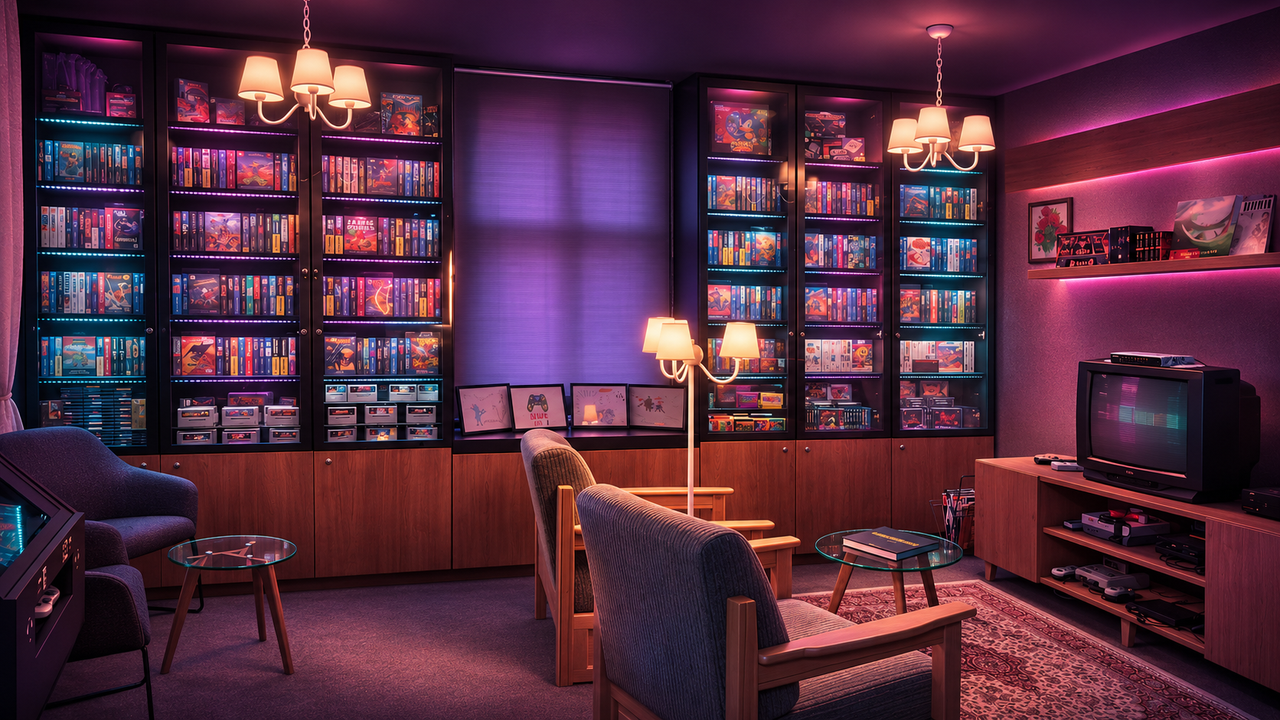
As we started bringing the final concept to life, authenticity became increasingly important to me. The cabinetry was custom-designed to create the right retro atmosphere while still being practical for displaying the collection. But many of the objects surrounding it have a much more personal history. The armchairs, for example, were brought from an old house in rural Bulgaria. They weren't selected from some fashionable furniture catalog to imitate the 1990s. They had actually lived through that era. The magazine stand belonged to my grandmother. The traditional lacework came from Kalofer, my grandmother's hometown. Anyone who grew up in a Bulgarian home during the 1990s probably remembers the almost sacred importance of decorative lace. It was everywhere, frequently protecting furniture that apparently wasn't allowed to experience direct contact with the outside world. And the framed needlework on display was made by my mother. These aren't random decorative props chosen to create an atmosphere. They're little pieces of my family's history. And then there's the television. Oh, that television.
The Television Expert Who Nearly Got Us Banned From Every Store
The CRT television in our Retro Living Room is the very same television my parents bought in 1998, for the FIFA World Cup in France. I remember it vividly, including the little sticker featuring the French rooster on the upper-right corner. But I remember the process of buying it even more clearly. Because my parents apparently decided that purchasing a television wasn't something ordinary people should attempt without professional assistance. They brought a TV expert. Now, you have to understand that I was a child who desperately wanted a new television at home. I didn't particularly care about the technical characteristics. I just wanted my parents to buy one so I could enjoy it. The expert, however, had other priorities. He would enter a store and start connecting televisions to some sort of testing device. Then he'd examine the picture, inspect the corners, check for visual imperfections, and eventually announce that the televisions were rubbish. All of them. Every single one. I remember repeatedly going shopping, getting excited that we'd finally bring our new television home, and then watching this man systematically destroy the reputation of every model in the store. Apparently, his standards were so demanding that at one point the staff at a shop were practically ready to throw him out. I was devastated. We'd go home without a television and wait for the next delivery of models that might, just might, satisfy this man's expectations. I honestly thought we were never going to buy one. But eventually, we did. And that television stayed with our family for decades. Now it's sitting in the Retro Living Room at Retro Gaming Bar, connected to the consoles and games that defined so much of my childhood. I wonder what that expert would think if he knew the television he'd spent so much effort selecting was still being used in 2026. I'd like to believe he'd be proud. Although knowing him, he'd probably take one look at the picture and start complaining about the geometry.
Content from YouTube is disabled.
Enable it in - Cookie Settings
Not a Retro Living Room. My Retro Living Room!
This is the part of the story that matters most to me. When people visit the Retro Living Room, they see a collection of classic games, original consoles, a CRT television, comfortable armchairs, and an interior that brings back memories of the 1990s. And that's exactly what I wanted them to experience. But for me, it's something more personal. That's my family's television. Those are objects from my parents' and grandparents' homes. The collection on the shelves represents years of searching, discovering, collecting, and preserving games that I genuinely love. Even the atmosphere is inspired by the rooms I remember from growing up. It isn't a museum exhibit assembled from a checklist of nostalgic objects. And it isn't a generic man cave designed to look good in photographs.
It's my living room. The one I've carried around in my memories for years, finally brought back to life so I can share it with everyone.
There's a wonderful contradiction in that idea. I wanted a place filled with retro gaming treasures, but I didn't want it to feel like a warehouse of collectibles. I wanted the games and consoles to exist naturally alongside the furniture, family decorations, and everyday objects that made those old living rooms feel like home. A little bit nerdy, absolutely. But also warm, familiar, and human. Because the memories aren't just about the games. They're about where we played them, who we played them with, and what life felt like at the time.
A Year and a Half Later, We Finally Got There
It took roughly a year and a half after opening RGB to turn that original corner into the Retro Living Room I'd imagined. There were other projects competing for time, plenty of practical challenges, and the usual endless chain of small improvements that somehow became enormous undertakings. But unlike our earliest experiments, this time we had experience on our side. We knew how to take an idea through design, construction, and implementation. We'd learned which parts needed careful planning, where professional expertise mattered, and how much patience was required to bring a concept to life properly. And when I finally saw the finished room, surrounded by the old consoles, the familiar furniture, my collection, and that wonderful CRT television, I knew the effort had been worth it. It's funny to think that the entire journey began with an idea to create a private man cave at home. Instead, I ended up creating a place where anyone can sit down, pick up an original controller, and enjoy a little piece of the past. And every time I enter Retro Gaming Bar, there's a moment when that corner catches my eye and takes me straight back to my childhood. Not because it looks vaguely like something from the 1990s. But because so much of it actually comes from my life.
I wanted to build a man cave for myself. Somehow, I ended up building one for everyone. And I wouldn't have it any other way.
Keep Exploring
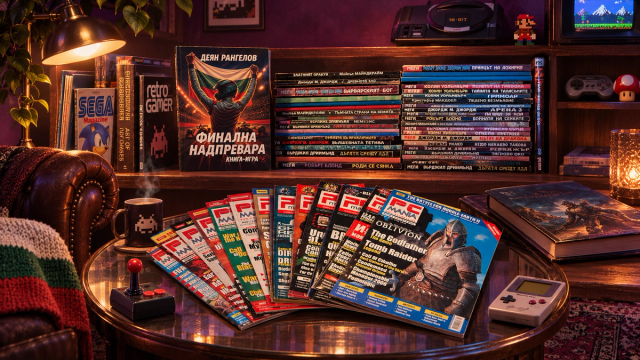
Beyond the Games: Books, Magazines & Gaming Memories at Retro Gaming Bar
Our collection doesn't end with cartridges, consoles, and controllers. There's an entire world of gaming history waiting to be discovered on our shelves.
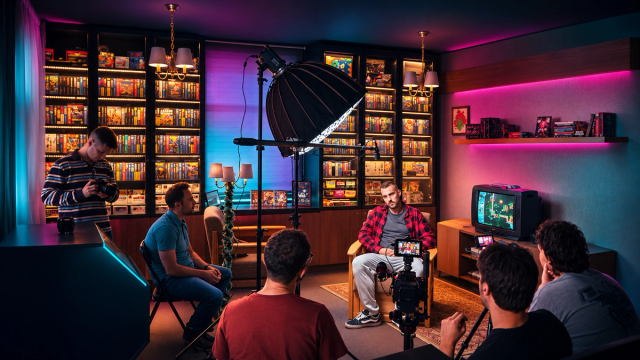
Lights, Camera, Retro! — Film Your Next Production at RGB
Looking for a filming location that's anything but ordinary? Welcome to Retro Gaming Bar.
Team Building in Sofia with Retro Games — A Different Kind of Corporate Experience
Bring your colleagues together, bring out their competitive side, and rediscover the joy of playing together.